Showing posts with label Mission. Show all posts

Thursday, April 26, 2012

Be Our Guest!


The Berry Center welcomes anyone to come explore our green roof, which is better known as the Berry Prairie.  In the spirit of Lumiere and Cogsworth in Beauty and the Beast, this post is constructed to show you just how welcome you are!

Guest Book and Brochure Rack

The Berry Prairie now features a guest book and brochure rack!  Information about the green roof and the plants it holds, as well as the Berry Center, are available for the taking.  Also, please sign the guest book to say hi and let us know what you think!!


Visitors explore the plants in the Berry Prairie

The first comments in our guest book!

Name Tags 

Many of the plants are labeled for your convenience - and we will continue to add labels as plants emerge from their winter slumber.  If you have any questions, feel free to stop in the main office inside the Berry Center doors and to the left.  Dorothy or I will be happy to provide answers!

Sorry Fito


One group of creatures we don't welcome are pets.  Dogs in particular find the open space an irresistible place to run in, which unfortunately can and has uprooted and trampled plants.  So sorry Fito, you have to stay out. 


 Stop by to check out the Prairie next time you're on this side of campus!


Written by Brenna Wanous, Berry Center

Thursday, November 3, 2011

Seasonal Senescence

"Winter!  Thou art e'er the grand finale,
Bringing death to all the fickle folly,
Of thy fair, but transient sisters.
List their requiem, the wind-wailed whispers.

All browned now and withered lie the leaves,
Gone are the circling swallows from the eaves;
The cheery summer scenes and sounds are past,
Winter reigneth supreme and rides the blast."

-"Winter" from Prairie Poems and Others by F.D. Dibble


Laramie's scene now involves snow and chilly breezes, and the Berry Prairie shows that well.  Now under an inch of snow, the plants are hunkering down for winter.  Following their cues, the Berry Prairie blog writers will take their senescence now too, until the new leaves pop up in spring.

Winter Projects
A couple of prairie-related projects we'll be working on this winter:

1. Weather: You'll see in the photo below that we have installed a weather station on the green roof, which monitors temperature, pressure, humidity, wind speeds, precipitation, dew point, and more.  


That information is routed to a receiver inside the building, which retains all of that data and allows the user (ahem, the people in the Berry Center) to download the information to a computer where we can analyze and share the trends and current conditions.  

2.  Propagation: Karen Panter (you remember her, right?  She's a UW faculty member who propagated a number of the commercially unavailable plants that we installed in the prairie) will be raising a number of seedlings again this winter.  She's focusing on those that didn't grow well last winter/spring, and those that weren't quite ready to be installed this summer. 


The green roof is still open for interested folks to visit, though it's not quite as interesting with most of the plants covered up with snow.  


Have a great winter, see you in the spring!

Written by Brenna Wanous, Berry Center

Wednesday, October 5, 2011

Cities as Bee Meccas

The BBC published an article in early August with an intriguing spin on pollinator conservation: bring them into the cities!  The UK-based research/survey project is trying to determine how many and what kinds of pollinators use urban gardens as their food and shelter oasis.  What do you think - a reasonable idea?

Click here to read the article.

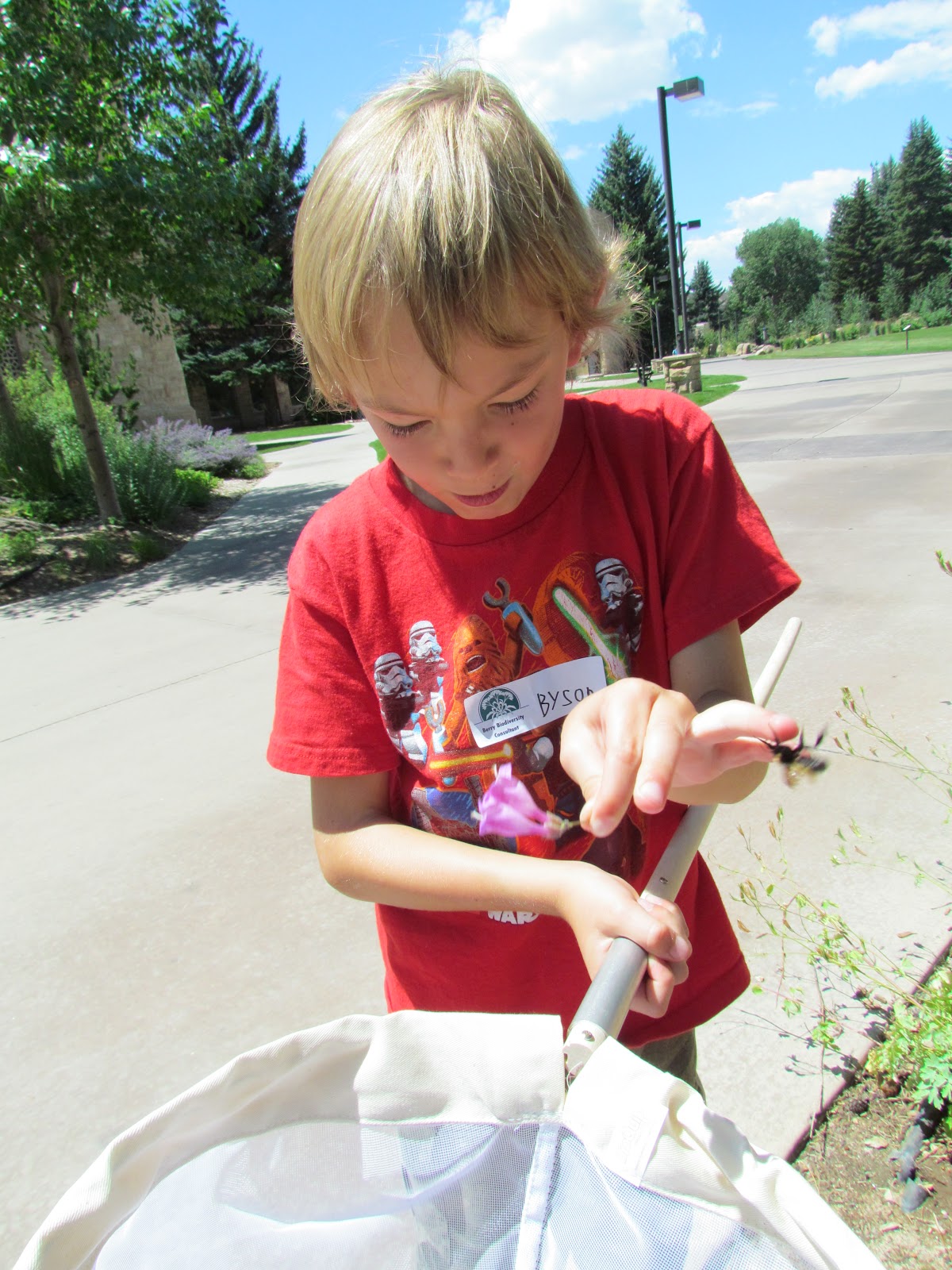
Byson, a student who visited the Berry Center this summer with the Children's Discovery Center in Cheyenne, made friends with a bumblebee who landed on his finger.  Read about their visit here.

Thursday, September 29, 2011

A Better Understanding of Biodiversity

What do we know about the Berry Prairie? We know it is unique, we know that it is beautiful and we know that there are over 60 native plant species that now call it home. But it is not so much what we know about the Berry Prairie that makes it the unique and beautiful landscape that it is, however, what we do not know. 

For example: We do not know how the substrate we planted in will evolve. We do not know how the plants (all 60+ species) will survive or which species will recede or begin to dominate the landscape. We do not know what kind of animals (vertebrate and invertebrates) will inhabit this new, native-urban environment…. We don’t know…. But we will!

As grad student in Botany/Berry Center, I have spent the last couple of weeks accumulating the base line data that will spring board us toward our understanding of just how unique and just how successful this project will be.  On hands and knees, through rain and shine, through wind and cold I have gracefully (and not so gracefully) crawled my way through the Prairie getting to ‘know’ it up close and personal. 

Through stratified random sampling, a common approach to vegetation ecology, I have surveyed over 1400 individual plants and over 30% of the total area of the Prairie to assess above ground biomass and percent cover in order to establish a foundation of data that will be used in correlation with substrate samples, weather and precipitation data and assessment of animal diversity to help define what we will come know about the Berry Prairie.


Although it is getting late in the year I am excited to report that during sampling I saw a number of amazing flowering plants Campanula, Clematis, Erigeron spp. A vast array of grasses gone to seed Poa, Bouteloua and Sporobolus spp. and a number of invertebrates from true bugs (Hemiptera) and Lady Bugs (Coccinellidae) to bees (Hymenoptera) and bee flies (Bombyliidae) and a number of arachnids. Already, in these short months since planting, we are seeing success in survivability and biodiversity on our Berry Prairie and I as well as we look forward to what the Spring brings to our unique prairie landscape.

Written by Kyle Bolenbaugh, Botany/Berry Center graduate student


Wednesday, August 10, 2011

Meet Kyle: Master in Training


This fall, the Berry Center is fortunate enough to hire a graduate student, Kyle Bolenbaugh.  Kyle will begin working on his Masters of Science degree at the University of Wyoming in the Department of Botany, working with the Berry Center's Director Greg Brown, who also hails from the botany department as a professor and department head.  Kyle will be monitoring and assessing multiple aspects of the Berry Center’s green roof, including species survivability, reproduction and seed set, adaptations, pollinators and more.  He received his bachelors degree from the University of Wyoming in microbiology in 2009.

Green Roof Wrangler

Some of you may remember Kyle from earlier this summer when he helped install the green roof in June (he's center-left in the photo below) as a volunteer turned hired-hand.  He has been watering the Berry Prairie every day since it was installed to ensure plants establish enough roots and biomass to make it through the intense summer sun and frigid winter... everything.  So far there have been less than a dozen plant moralities, largely due to Kyle's attention and dedication.

Kyle Bolenbaugh, in the center with the orange shirt, volunteered for the green roof installation project.  Starting August 22, he'll be the Berry Prairie's first graduate student.

Kyle also helped Dorothy with the group of day care kids from Cheyenne learn about plants, pollinators and their connections.

Kyle helps three children identify the insect they caught in their net.  July 29, 2011


The Big Picture

Supporting Kyle's research is one of the ways the Berry Biodiversity Conservation Center seeks to ensure education, research and public engagement are its central focuses, and this includes the Berry Prairie in a big way.  The approach used in creating the Berry Prairie is fairly new in the green roof movement, so there is a need to systematically study its progress, challenges and successes, as well as widely share our findings.  Kyle's dedication to studying the science of the green roof will help ensure this mission is appropriately carried out.

You'll be seeing more of Kyle over the next two years - stop by and say hello if you see him watering, weeding, counting, observing or just generally hanging out.


Written by Brenna Wanous, Berry Center

Wednesday, July 20, 2011

Sod Houses to Skyscrapers

A green-roofed house in Wales
Green roofs are not a new concept.  Centuries ago, Norwegians began using turf roofs to insulate their houses through the long winters, home owners and builders in Iceland and Germany have been improving the green roof technology over the past 250 years, and if you really want to stretch it back, the floating gardens of Babylon were maybe the first uses of green roofs.  Heck, even Frodo Baggins and Laura Ingalls Wilder had one… supposedly.

Now-a-days…
But green roofs now are different from back then.  You can’t just lay down strips of sod on a building – most buildings aren’t built with a green roof in mind so don’t have the structural strength for it.  Can you imagine how heavy a large scale lawn above your office would be after it rains? (or more applicable to Laramie, after it snows?)

Buildings that are constructed with a green roof in mind can plan ahead for it.  Structural reinforcements are clutch.  In fact, Switzerland mandates that all new buildings possess green roofs or walls - 25% of the surface area must be greened;  Toronto has a similar law.  And in Dearborn, MI, the Ford plant has a 10.4 acre green roof!  That takes a lot of planning ahead!

Thanks to modern technology, green roofs are more feasible because of:
  • Growing media.  Modern green roofs use soilless “soil” that is lightweight and drains well.  (More on the Berry Prairie soil soon.)
  • Layers.  Multiple layers create a green roof – the roof itself, a water-proof membrane, a drainage layer (involving a series of empty trays for collecting and draining excess water), a semi-permeable membrane to hold some water but drain extra, and the “soil.”

  • Plants.  Not every plant can rough it on a green roof.  Many green roofs use only a select few plant species because they’re tough and stubborn.  (This is where the Berry Center deviates from the norm.)

Not Just for Sedum
In the US, green roofs are commonly planted with sedum – a hard-core plant that can fight drought and extreme sun with the best of them.  This species is good for people who want/need low-maintenance roofs, but it doesn’t do much for biodiversity.  One species can’t attract many or an assortment of pollinators, spiders or birds, and it can’t create a mini-ecosystem.

An entirely different approach to green roofs is growing edibles (check out greenroofgrowers.blogspot.com).  Creating  a roof-top garden of tomatoes, peppers, squash and zucchini is a growing trend for individuals and schools, particularly in urban environments were open ground space is hard to come by.  Low cost, few complications, high success and high versatility.


The Berry Center’s green roof is different yet.  By planting almost 60 species of native plants, we hope to create a mini-ecosystem that teaches passersby about what thrives in the Laramie basin – including plants, bees, butterflies, beetles, arachnids and more.

Green Roof Gamble
But the Berry Prairie is experimental – one has never been planted at this elevation, and very few are planted in this style.  Will this approach to green roofing work?  Will the plants survive over the Wyoming winters?  Is the growing medium right for these species?  Will plants regenerate and reproduce to create a self-maintaining ecosystem?  Will it require more water and nutrient inputs than we expect?

“The Grand Experiment” as Berry Center Director Greg Brown likes to call it.  The questions are part of the fun.

It takes a while for plants to established, but we're encouraged that many of them are flowering now.
July 19, 2011

 Written by Brenna Wanous, Berry Center

Thursday, June 16, 2011

Green Roof Foundations

Penstemon virens blooming on a boulder
in front of the Berry Center.
In Wyoming, survival of the fittest is obvious.  Those which flourish are the rugged and the tough, the adaptable and the persistent.  Plants are no exception to the rule.  To test a variety of factors that impact a plant species’ or community’s success, the Berry Biodiversity Conservation Center at the University of Wyoming is installing Laramie’s first large-scale green roof.  Right now, the roof is more brown than green.  But come the end of June, it will have native plants stationed and ready for action.


The Mission

Install, monitor and evaluate native Wyoming plant species in a human-created environment above the Vertebrate Collections at the Berry Center.  To our knowledge, a green roof at this latitude, elevation and variety (all native!) has not been installed before.


The Environment
Laramie is located in southeastern Wyoming at 7200’ above sea level.  The city and surrounding area receive an average of 11” of precipitation per year – the same as Tuscon, Arizona, and would be classified as desert, was it not for the cold winters.  The area experiences an average of 300 days of sunshine per year, and the strength of the sun is amplified but Laramie’s high elevation.  Wind is an important player here, as wind speeds are commonly around 20 mph and can get as high as 60 mph on a blustery day.


The Questions
  • Can we mimic natural processes by planting native Wyoming flowers, grasses, shrubs and cacti to create a mini rooftop prairie? If not, what adjustments must be made?   
  • Does a green roof at 7200’ above sea level operate the same way as one at much lower elevation?   
  • What traits distinguish those plant species that survive or thrive on the green roof from those that don’t?   
  • Can we draw pollinators, spiders, beetles, and other matrix-level species to the green roof, and how can we foster their presence? 


The Big Picture

Biodiversity is wildly important to the maintenance of a healthy environment in a variety of ways (if you’re not sure why or which ways, do a quick on-line search).  Experimenting with ways to conserve, protect and reestablish biological diversity in an urban environment is as important to future generations as is the protection of natural environments.  The Berry Biodiversity Conservation Center is home to multiple scientific labs for the study of diversity, from genes to ecosystems – and a green roof is one more way to enhance our understanding of community processes.


Stay tuned.  Installation is scheduled for the week of June 27.

Planting of the Berry Center green roof is schedule to
begin June 27, 2011.

Written by Brenna Wanous, Berry Center