Showing posts with label biodiversity. Show all posts

Thursday, June 23, 2016

Hey there good lookin'!

In the words of Ron Burgandy (well, paraphrased), the Berry Prairie looks good.  I mean, really good.  Hey everybody - come and see how good it looks!  The plants are just as lush as can be, and the diversity of flowers is fabulous.  Stop in any time to get an up-close look!


Bitterroot

Blanketflower featuring a sweat bee

Fescue


The Prairie Smoke are looking smokey!

Twinpod seeds

Wood Lily

Written by Brenna Marsicek, UW Biodiversity Institute

Friday, May 29, 2015

Lots of Lichens


We have a non-plant living on the green roof.  They're very common in Wyoming, but can be quite hidden from first glance.  They look like they could be plants, but they're two entirely different organisms put together.  What are they?  Lichens of course!

Xanthoparmelia chlorochroa, aka tumbleweed shield lichen, is far and away the most abundant lichen in Wyoming. It is unusual in that it is not attached to a substrate (like rock or bark), and it blows about, sometimes accumulating in drifts, especially where vegetation is limited.

Tumbleweed Shield Lichen

In drought years, when plants are not very productive, tumbleweed shield lichen seems really abundant, but likely that’s because it is more visible then. Unfortunately, there have been incidents during drought years when elk have eaten large amounts of the lichen. The organic acids produced by the lichen cause paralysis in elk, so they die of thirst. On the other hand, tumbleweed shield lichen is a favored food of pronghorn, and has long been used as a source of reddish dye and a cure for impetigo by the Navajo.

Lichens are super cool superorganisms! They are really two organisms - a fungus and an alga. Most of what you see is the fungus, but there are photosynthesizing alga cells just below the upper surface.

A cross-section of a lichen

In trade for the moist, sheltered, and nutrient-rich environment that the fungus provides, the alga shares the carbohydrates it makes via photosynthesis with the fungus. Both organisms win! This is a classic example of commensalism, a symbiotic association where both members benefit. And, it is a very successful relationship - there are more than 700 species of lichens in Wyoming, and at least 20,000 worldwide, with new ones discovered all the time.

To paraphrase E. O. Wilson, if you want to discover new species, you should become a lichenologist!

Written by Dorothy Tuthill, UW Biodiversity Institute

Thursday, June 5, 2014

Indian Paintbrush Garden

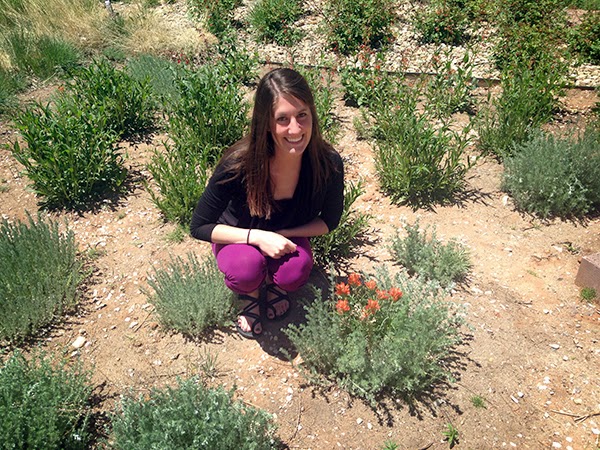
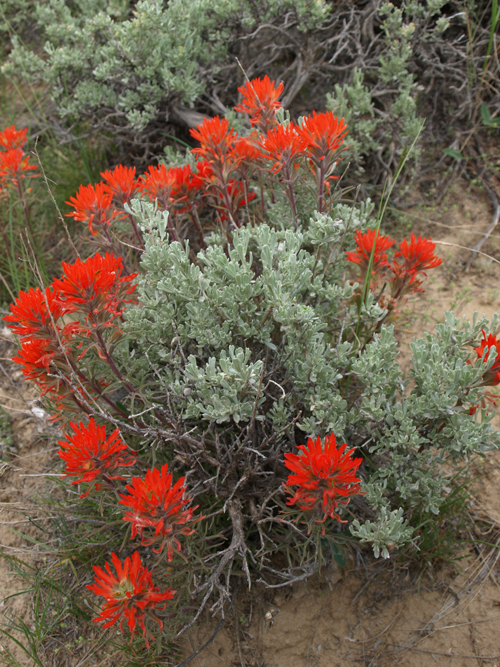
Last summer our garden intern, Jenna Ramunno, started a project that looked at propagating Indian Paintbrush (Castilleja spp.) with four different types of host plants to see which host plant best serves the paintbrush.  In case you haven't read, Indian Paintbrush are hemi-parasites, meaning they attach their roots the the roots of another plant to siphon off some water and maybe nutrients.  Without a host plant, paintbrush would be able to survive, but likely not bloom.  It doesn't hurt the host plant, but gives the paintbrush some extra blooming power!

This spring, the paintbrush came back beautifully!  And even attracting some unwanted biodiversity...


Here's triumphant Jenna, one year after starting the experiment.


We'll be keeping track of the progress this summer, so stay tuned for updates!


Written by Brenna Marsicek, UW Biodiversity Institute

Thursday, April 17, 2014

Here Comes Peter Cottontail

The Berry Prairie has become home to approximately 60 species of native grasses, forbs and shrubs, as well as 8 orders of insects (according to Master's student, Kyle Bolenbaugh, who is studying the green roof).  Of course humans frequent the roof regularly, but this winter we added one more vertebrate species to our Celebrity Spotlight list: a rabbit!


These hippity hoppity little buggers are pretty darn cute.  And of course we love to brag that the roof is a biodiversity hotspot (ha!).  However, they happened to have destroyed every single one of our ball cacti on the roof, putting them on our black list for eternity. 

In all of the red circles there used to be a beautiful cactus.  Now there are only divots to honor our fallen succulents.


Now, cacti are not typically a rabbit's favorite snack.  I am certain you can imagine why.  Spiny, tough, blah.  But they do offer desperate animals one necessary resource, and that is water.

Winters in Wyoming tend to be long and windy, and we don't usually get a ton of snow.  So rabbits and other organisms that are active throughout the winter need an accessible (aka non-frozen and above ground) water source.  If there's no snow nearby, and no other puddles or rivers, the water pooled inside a cactus might be the only or best option.  Despite the spines. 


The photo above shows the poor amputated cactus, post rabbit attack.  The photo below, the former site of a cactus.


Moral of this story: not even heavily armed organisms are safe against the onslaught of thirsty rabbits.


Written by Brenna Marsicek, Biodiversity Institute

Wednesday, August 14, 2013

Prairie Update

Whoa, it's been a long time since we put anything new up here!  We've been hopping around the state doing outdoor education programs and pollinator awareness events, and haven't spent much time in the office.  Speaking of pollinators, I have a cool story for you about bees in Rock Springs - that'll come later.

Anyway, how about a green roof update?  I've been defending the term "green" roof lately, since the Berry Prairie isn't looking too green these days.  As you know, that's a term for a living roof, and our unusual plant selection doesn't always jive with the nomenclature.  I guess it's a tan roof with patches of green?  


Blooming Updates:

1. The beautiful Liatris (Liatris lewisii), also known as the Gayfeather, is in bloom.  This individual is short in stature, but the color packs a punch.  In larger bunches, these are pollinator meccas, with the flower heads usually vibrating with the number of bees on it.  Also, as you may recall, it was one of the only plants that still bloomed during the whole green roof removal debacle last year.


2.  The Laramie Columbine (Aquilegia laramiensis) has been blooming throughout the summer, one individual after another.  This is the largest of the blooms we've seen this year, isn't it fabulous?  


Trail Grasses Update

The grasses we are testing out with a few other green roofs are getting established.  You'll see that the Sun Sedge (which is not a grass) is loving life.  They've each put on new growth this year, and we're hopeful that this strand of blue grama will be a better fit for the green roof than the strand we have now.  So far the hairy grama isn't looking too spectacular, but it's still early.


New growth on the blue grama


Blue grama


Hairy grama
Sand dropseed
Sun sedge

Stay tuned for Kyle's post on the results of his survivability research, and on pollinators in Rock Springs, WY!


Written by Brenna Marsicek, Biodiversity Institute


Monday, July 22, 2013

Trial Run

A couple of weeks ago, Dr. Richard Sutton, professor of agronomy and horticulture at University of Nebraska-Lincoln, sent us an email to see if we'd like to try out a few different prairie plants on the green roof.  It's part of a larger research project (see their website here) trailing three species' survivability and persistence through dry periods, cold, and varying "soil" depths. 

Dr. Sutton was kind enough to send us not only the three species they're studying to try out on the Berry Prairie as part of the study, but also a fourth that he recommended would do well - and four of each species.  We're curious folk over here, so thought we'd give it a whirl.

New arrivals!

So here's what we received and planted:

Blue Grama (Bouteloua gracilis 'Conard')

This common short-grass prairie species was already planted on the green roof, but this particular variety ('Conard') is new to us.  Blue grama is a staple in Wyoming, and on the Berry Prairie too - we have over 900 individual plants of this species planted!  Let's see how this variety does.


Hairy Grama (Bouteloua hirsuta)

This cousin to Blue grama is found in the very eastern edge of Wyoming (see the Rocky Mountain Herbarium site).  Although it's not found within 30 miles of Laramie, as all of our other plants, it is an interesting grass.  See how the anthers dangle below the flower of the grass?  That's what makes it "hairy."

Hairy grama flower

Blue grama flower

Sun Sedge (Carex inops heliophila)

This sedge is found through the eastern third(ish) of the state - see the map here.  It's an early season sedge so is often one of the first plants to green up in the spring (Forest Service website). 


Sand Dropseed (Sporobolus cryotandrus)

This grass is a warm weather (late summer) bloomer that prefers dry, usually sandy areas.  It's found throughout North America.  [Prairie dropseed is my personal favorite of the Wyoming grasses, but perhaps this one will win my heart.]

Photo from Prairie Moon Nursery


Stay tuned for their progress.


Written by Brenna Marsicek, Biodiversity Institute

Monday, July 8, 2013

Paintbrush Update

About a month ago I planted 29 Castilleja seedlings, 19 of which are Castilleja sessiliflora and 10 are Castilleja integra. Each Paintbrush was paired with one of three different host plants: Fringed sage (Artemisia frigida), Firecracker Penstemon (Penstemon eatonii), and Rocky Mountain Penstemon (P. strictus).

All of the host plants seem to be doing very well. Some of the initial seedlings planted do not look very healthy; however, if you take a closer look there appears to be a substantial amount of new growth underneath. So far the Castilleja sessiliflora paired with the Rocky Mountain Penstemon look the best. This pair has some new growth and others that look about the same. The total number of dead Castilleja is 3, all are Sessiliflora and all three have a different host plant. We do not know the reason for these deaths, but transplantation is often very stressful for plants. There is not enough information to say that one host plant works better than another at this point.

I had the opportunity to transplant wild Paintbrush from my parents’ property in Monument, Colorado. This experiment will allow us to see how robust these plants are and if transplanting is an option for growing. My parents dug up associated plants, as well, but we can’t tell which plant is the host (if any). These transplanted Paintbrushes gave the garden color and attracted pollinators as well as viewers. It gave the garden the aesthetics it was lacking. They flowered for about a month; a few are still flowering and hopefully they will all return next year. We are not advocating that anyone collect paintbrush or any other wildflower from land not your own! Because one species of Paintbrush (C. linariifolia) is Wyoming’s state flower, it is protected, so in this state it should not even be picked. 


The Colorado flowers are fading.  We think these are C. integra.


The third experiment I am trying is to grow Paintbrush from seeds. It takes Castilleja seeds around 60-90 days to germinate and requires a cold treatment to break dormancy. We placed Castilleja angustifolia and Castilleja chromosa seeds in the refrigerator on April 11, 2013, and they are just now germinating. I planted them in a plug tray to see if they will sprout, and then hopefully plant them outside. 


These tiny seedlings are C. chromosa, one week after planting.


All of these plants are found near the South doors to the Berry Center. It is not very colorful at this time because they are not flowering. Come by and check them out for yourself and see if you can tell the difference between the Castilleja sessiliflora and the Castilleja integra.


 Written by Jenna Ramunno, Biodiversity Institute


Tuesday, July 2, 2013

The Germinator

As you may know, a number of the plants on the Berry Prairie were grown from seed, specifically for use on the green roof.  Starting wildflowers from seed can be as easy as throwing them on the soil.  More often, however, it takes careful and strategic processes that range from refrigeration to scratching to freezing to burning.  The post below gives an overview of the many ways we germinate seeds, including as it relates to Jenna's Indian Paintbrush project.

________________________________________________________________

Seed Germination

Not every seed will grow as soon as it is in the ground. Seed dormancy is the failure of a viable seed to germinate under adequate environmental conditions; a seed will germinate after dormancy is overcome or broken. Seed dormancy is desired in the wild because plants depend on nature for survival. If a seed germinates but the conditions are not right for growth the seedling will die. Some seeds require stratification while others require scarification.

Penstemin eriantherus blooming on the Berry Prairie.


Scarification is where the seed coat is scratched to loosen the covering. The seed will not germinate until the seed coat is altered physically, to make it permeable to water. This happens in different ways in nature. One way is by a seed falling, or being scratched on a rough surface. Another example of scarification can occur is when it passes through the digestive tract of various animals. Strawberries and raspberries are an example. Frugivores, like bears, digest the fruit pulp, but the seed coat passes through the digestive system and the acid in the digestive track breaks down the seed coat making it ready for germination.

Castilleja chromosa seed just starting to germinate
after 2 months in the fridge.
Stratification is when a seed undergoes a cold or hot treatment to break dormancy. This happens in nature when it snows in the winter. Many of our native wildflowers require stratification. For example, when Karen Panter started Penstemon eriantherus for the Berry Prairie, she kept the moist seeds in the refrigerator for up to three months before planting! Seeds can be put in moist soil or perlite, or even just in plastic bag with a bit of water, before refrigeration. We used this last technique to germinate Indian paintbrush seeds—read more about that soon.

Another way to stratify seeds is to plant them during the late autumn or winter, and leave the pots outside over winter. Some plants will germinate even better the second year, after overwintering twice.

The fires that occurred this summer and last in Colorado have created a lot of destruction. Even though it does not seem like it, the fires have also created growth. The heat of the fire actually weakens the covering of some kinds of seeds enough to enable it to intake moisture and germinate. This is common for pinecones; they are tightly shut and the heat allows them to open and release the seeds.

The wildflower Corydalis aurea is common after wildfires.
Fire stimulates its long-lived seeds to germinate.


Written by Jenna Ramunno, Biodiversity Institute


Tuesday, June 18, 2013

Prairie Spotlight: Sagebrush

Wyoming residents tend to have a misconstrued conception of sagebrush: “The brown-green stuff that grows everywhere.” Many ranchers would like to reduce its abundance because it is poor livestock food; it competes with preferred grasses for water and nutrients. However, wildlife biologists recognize sagebrush as feed for deer, elk, and pronghorn antelope during the winter. Some view sagebrush as barren land, while others appreciate its unique aroma especially after a summer rain. [1] 

Artemisia tridentata: the name means
3-toothed, a feature of the leaves.
There are five major types of sagebrush in Wyoming: Artemisia cana (Silver sage), Artemisia tridentata (Big sagebrush), Artemisia frigida (Fringed sage), Artemisia nova (Black sage), and Artemisia pedatifida (Birdfoot sage). All of these can be found on the Berry Prairie. 


Artemisia peatifida: this sagebrush is restricted
to most of Wyoming, and only a small part
of south-central Montana.


Why Care about Sagebrush?

Sagebrush is interesting because it grows in places like Wyoming where there is little rain, winters are harsh, and high winds. It depends on the wind for pollination. Second, it provides critically important habitat for a number of wildlife, such as sage grouse, sage thrasher, sage sparrow, and pygmy rabbits.[2]  Third, sagebrush is interesting because the genus belongs to the family Asteraceae, the same family as the sunflower even though it does not have the pretty flowers as the sunflower does. 


Photo by Cody Bish
Finally, sagebrush is an important host plant for a favorite wildflower. It is often used as a host plant for Castilleja or Indian paintbrush. The roots of sagebrush display an opportunistic growth strategy. It produces a taproot that elongates into the ground to reach available soil moisture, and also a network of roots that spreads laterally, giving the Castilleja haustoria roots a network to connect with.


[1] Dennis H. knight Mountains and Plains. The Ecology of Wyoming Landscapes

[2] Pocket Guide to Sagebrush


Written by Jenna Ramunno, Biodiversity Institute

Wednesday, June 12, 2013

Rock Garden

Penstemon virens is in bloom! It’s a lovely purple gem on the Berry Prairie, but it blooms even better on the rocks of our patio. These rocks—and those all across campus—were collected in the hills to the east of Laramie, and came with their own rock gardens! 


Blue Mist Penstemon (Penstemon virens)

Penstemon is a large genus of wildflowers with snapdragon-like flowers, usually in red, pink, purple or blue. The Berry Prairie is home to five species, one of which white—an atypical color for penstemons. More on that one later—its buds are still small.  “Virens” means green, a reference to the shiny, dark green leaves of P. virens. Despite its relatively small size (usually less than 10”), it provides lots of color this time of year because it’s both abundant and floriferous. It can be grown easily from seed, if you want it in your garden, and can sometimes be found at nurseries, too.

Our rock gardens include more than P. virens:  A quick sampling includes a currant bush, a groundsel, and a scientist on lunch break!


Groundsel growing with penstemon virens

Current bush in the rock

Homo sapien amongst the vegetation


Written by Dorothy Tuthill, Biodiversity Institute


Monday, June 10, 2013

So Many Activities!

The green roof is hoppin'.  With so much going on lately, this post might come across a bit scattered.  Apologies for the linear-minded out there!  It's been warm here (it's currently 86.3 degrees), it's field season, and coincidentally we finished a signage project.

Update #1: New Blooms

With the warm weather we've had lately, it's facilitated lots of growth on the roof.  There are two more plants in bloom, the Blue Flag Iris (Iris missouriensis) as well as the Blue Mist Penstemon (Penstemon virens).  The Stonecrop (Sedum lanceolatum) is just about to burst open too, more pictures when that happens.


Can you spot the mason bee pollinating this plant??  Bees (and hummingbirds) love penstemon!

Update #2: Tents

Graduate student Kyle Bolenbaugh is looking at which insects frequent the green roof (in addition to which plants survive the winter cold and summer dryness).  This tent captures insects so Kyle can get a closer look.


Update #3: Signs!

A project a year in the making, we have installed two signs on the railing leading to the green roof to explain what the heck this patch of dirt is.  They're pretty.  Dennis Henry of Click Point Ranch in Denver coordinated the design, manufacturing and installation.  Thanks Dennis!


Dennis Henry of Click Point Ranch

Stop by to check out all of the activity!  The gate is open and guests are welcome.


Written by Brenna Marsicek, Biodiversity Institute