Showing posts with label species. Show all posts

Tuesday, August 23, 2016

The Tale of the Scarlet Gilia

Scarlet Gilia.  The name conjures up an air of mystery, of dominance.  Perhaps a Spanish accent.  Like the side-kick to Zorro.  Ole.

And indeed, Scarlet Gilia (Ipomopsis aggregata) is a pretty fabulous plant.  Bright red tubular flowers hanging off tall, narrow stems, and leaves so narrow they almost look coniferous.  They bloom late in the summer (August), and hummingbirds and hawk moths love these beautiful flowers.  Drought tolerant and doesn't require much for nutrient input, this plant is great for Wyoming gardens.


Scarlet Gilia is a biennial, meaning it will bloom only after spending a year incognito.  I guess being this stunning takes a year of prep.  It will spend year 1 as a short rosette of leaves, and year 2 spring up with flower stalks.  It dies after blooming, but it is a heavy reseeder so you will likely get many new rosettes in the garden in year 3. 

We are in an off-year for Scarlet Gilia on the Berry Prairie.  Last summer, the green roof looked like it was to be overtaken by this species.  This year, we have just a couple plants in bloom:


And just wait for 2017; the Berry Prairie will be a sea of red in August.  And then we will learn if it really does have a Spanish accent.

Written by Brenna Marsicek, UW Biodiversity Institute

Thursday, July 7, 2016

Truffula Trees

I discovered what must have been Dr. Seuss's inspiration.   Can you believe that the Berry Prairie has real-live miniature truffula trees?!


Ok so they're not actual truffula trees.  They're the seed heads of Sugarbowl Clematis (Clematis hirsutissima var. scottii), which look like this when in bloom:


Sugarbowl Clematis is native to Wyoming, Colorado, South Dakota, Utah, Oklahoma, New Mexico and western Nebraska, and grows in the foothills of the mountains as well as woodlands and mountain meadows.  Not exactly the same habitat as truffula trees.

But couldn't you just imagine the Lorax wandering about the garden, singing and jumping and being his jovial little self?


Well, it was fun to dream.  Here's to the inner child in each of us!


Written by Brenna Marsicek, UW Biodiversity Institute

Thursday, June 23, 2016

Hey there good lookin'!

In the words of Ron Burgandy (well, paraphrased), the Berry Prairie looks good.  I mean, really good.  Hey everybody - come and see how good it looks!  The plants are just as lush as can be, and the diversity of flowers is fabulous.  Stop in any time to get an up-close look!


Bitterroot

Blanketflower featuring a sweat bee

Fescue


The Prairie Smoke are looking smokey!

Twinpod seeds

Wood Lily

Written by Brenna Marsicek, UW Biodiversity Institute

Wednesday, June 8, 2016

Asteraceaes in Bloom!

The Berry Prairie plants are going nuts. So many in bloom right now! A group of flowers in the Asteraceae family, or the sunflower family, have a number of species in bloom right now. Below, Charmaine Delmatier, Director of the Rocky Mountain Herbarium Volunteer Program at the University of Wyoming, describes three that are in bloom right now.

Old-Man-of-the-Mountain (Tetraneuris grandiflora

Old-Man-of-the-Mountain (Tetraneuris grandiflora)
Also known as alpine sunflower, Old-Man-of-the-Mountain gets its name from a distinguishing characteristic; its hairs. Long villous wooly hairs cover much of the soft feathery leaves and a soft tomentose of shorter densely tangled hairs coat the peduncle (a stem-like structure that subtends each flowering head or involucre). A member of the sunflower family, Asteraceae, Old-Man-of-the-Mountain displays one of the showiest-brightest yellow-flowering heads in open areas of the alpine. It stands no taller than 12 inches, but the bundle of 1 – 10 flowering heads can also reach as wide as a foot. As the plant matures, its yellow vibrant color fades to tan. The enjoyment of seeing this spectacular alpine sunflower is that where it grows it can be locally abundant producing a refreshing display of color amidst the rocky gray landscape.


Lavender Fleabane (Erigeron sp.)

Lavender Fleabane (Erigeron sp.)
Fleabanes are a member of the sunflower family, Asteraceae, the largest plant family in the world with 23,000 species. The genus Erigeron, commonly known as a fleabane, is a daisy-like flowering herbaceous forb in the sunflower family. The Greek derivative "eri" literally translates to early. It is an appropriate name since the flowers bloom in early spring. According to distant folklore, gathering Erigerons in the wild and placing them inside a home prevents an unwanted infestation of fleas. You might wonder how to tell Asters from Erigerons. Here’s a quick solution; Asters can have several rows of bracts surrounding the flower, overlapping like roof shingles, but Erigerons have neatly uniform rows.


Stemless Goldenweed (Stenotus acaulis)


Stemless goldenweed (Stenotus acaulis)

A brilliant yellow and smaller member of the sunflower family (Asteraceae), stemless goldenweed (Stenotus acaulis) bursts with golden color revealing the beginning of spring between April and May. Caleb A. Morse has determined that within the Flora of North America there is a mere four species; which spread across western North America and northwest Mexico. The sunflower family, Asteraceae, derives its root from the Greek Titan goddess, Asteria, (goddess of falling stars). According to one Greek myth; when she looked down upon the earth, and saw no stars, she began to weep. Where a tear fell upon the earth, a star was born, hence the name ‘starwort’. This became a common term for members of the Asteraceae family. The term ‘wort’ translates to ‘plant’ in Old English, so the largest plant family in the world is interestingly a collection of ‘starplants’.


Dwarf Mountain Fleabane or Cutleaf Daisy (Erigeron compositus var. discoidea)

Cutleaf Daisy (Erigeron compositus var. discoidea)

Alpine fleabane or mountain fleabane is an early bloomer in the sunflower family with large bright white flowering heads sitting singularly on a stem, and there are many stems, painting the landscape with bright white mounds in what often is a stark rocky habitat. It is a short compact plant and often thought of as an alpine or arctic plant. However, it’s interesting that its common name is associated with lands that have a large range in elevation; actually having lowlands and highlands, but here in Wyoming we all know we live in a high place and you will find it distributed across the state. Be somewhat careful if you handle this small unassuming plant, it is known to cause a bit of dermatitis.


Written by Charmaine Delmatier, Rocky Mountain Herbarium

Tuesday, May 31, 2016

You Say Clematis, I Say Clematis

The Berry Prairie's clematis is in bloom!  Now, if you're envisioning a clematis like this:


Sorry, that's not it.

Our clematis is small.  Its flowers hang upside-down.  It stays low to the ground and scoffs at a trellis.  It's pollinated by a variety of insects, but big, burly bumble bees in particular love it.  It's native to our great state of Wyoming.  What more could you want in a clematis?

Viewers, meet the Sugarbowl Clematis (Clematis scotii)!


Check back again soon for updates on other flowers in bloom.  There are lots - if you're in Laramie, feel welcome to visit the green roof any time, any day of the week!


Written by Brenna Marsicek, UW Biodiversity Institute

Thursday, May 26, 2016

Rare Columbines in Bloom!


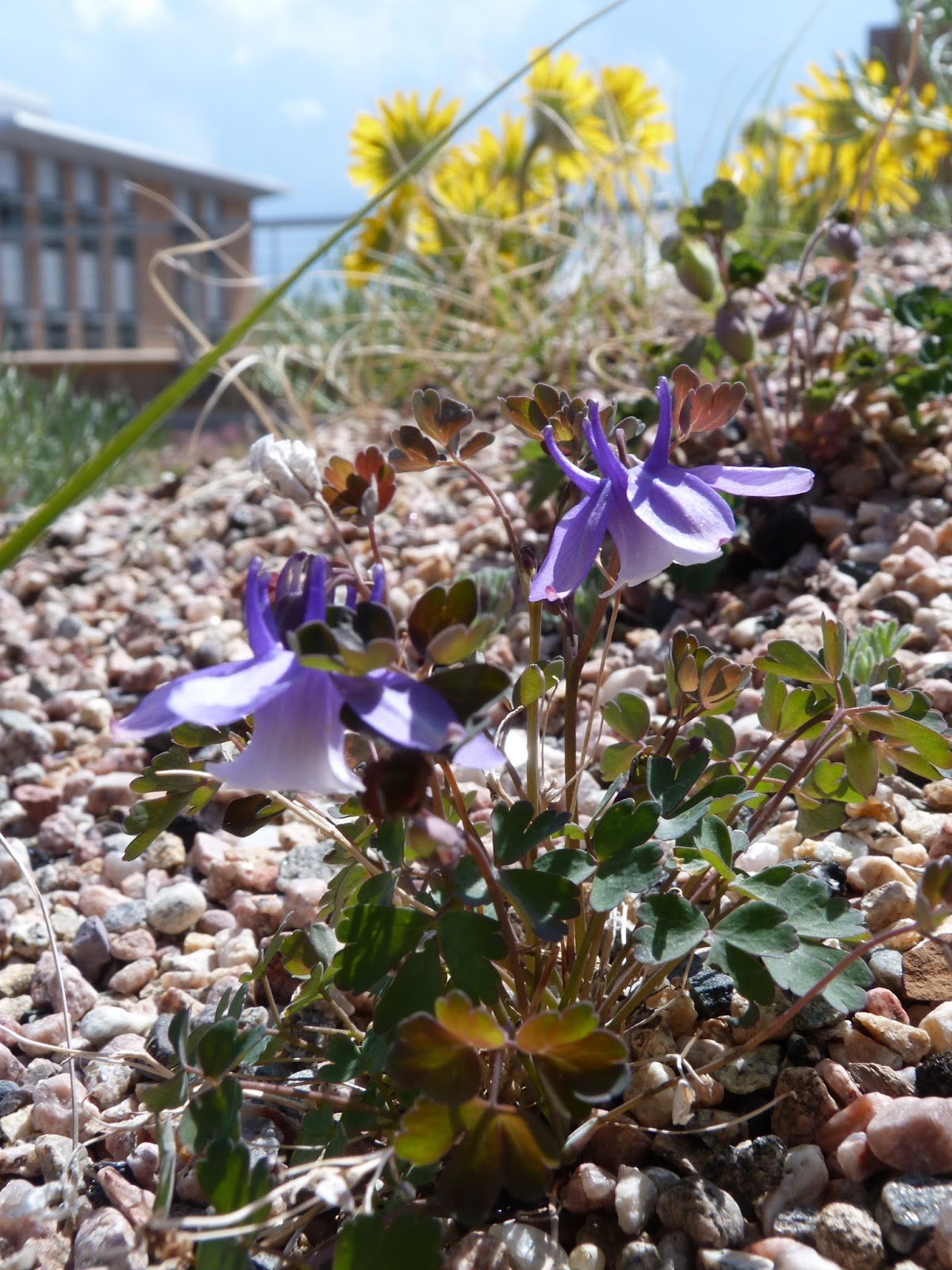
Three petite columbines with restricted home ranges are currently in bloom on the Berry Prairie.

Rocky Mountain columbine (Aquilegia saximontana) has the largest flowers of the three, beautiful deep blue, and about an inch and a half across, though the entire plant is barely six inches tall. Rocky Mountain columbine is an alpine and subalpine species, found in the wild in only a few counties of north-central Colorado.  Read an earlier post about Rocky Mountain columbine here.


Rocky Mountain columbine (Aquilegia saximontana)


Equally blue, but smaller, is Jones’ columbine (Aquilegia jonesii). The smallest of all columbines, Jones’ columbine is found on alpine and subalpine ridges and talus from southern Alberta to northern Wyoming, including the Bighorn Mountains.

Jones’ columbine (Aquilegia jonesii)


Besides the size difference (which isn’t great!), these two blue columbines can be distinguished on the Berry Prairie by the shape of their floral spurs. (In the wild, of course, you would never find these two growing together.) Jones’ columbine has short, straight spurs, while those of Rocky Mountain columbine are curved (“hooked” is the botanic term).  Learn more about spurs here!

Hooked spurs is an unusual trait among columbines, but is shared by the third of our flowering columbines—Laramie columbine (Aquilegia laramiensis). This species is endemic to the Laramie Range of eastern Wyoming, where it grows in cracks and crevices of exposed granite.  Read an earlier post that features the Laramie columbine.

Laramie columbine (Aquilegia laramiensis)


Stay tuned for more updates on flowering plants on the Berry Prairie this summer!

Written by Dorothy Tuthill, UW Biodiversity Institute

Wednesday, May 4, 2016

Hustlin' and Bustlin'

The Berry Prairie is alive with color!  Spring has sprung, hooray hooray!  The redesigned roof looks great after it's second winter, with loads of plants popping leaves, sprouts, flower buds and flowers, and we're excited to see what the summer brings.  Plants seem to be hustling to flower, ready to present their flowers, pollen and nectar to the world and reproduce.  And there are lots of pollinators about, willing to oblige them!

Here's a photo list of the species currently in bloom.

First and foremost, this display of what is normally a diminutive flower is dazzling.  Fewseed Draba, always one of the first to bloom in the spring, is putting on quite the show.  Bees and flies were buzzing all over these clumps.


This pasqueflower (Pulsatilla patens) is the only one on the roof currently in bloom.  These gems are one of the hardiest and pollinator-friendly flowers of early spring.


Prairie smoke, oh how I love prairie smoke (Geum triflorum).  First the pink nodding flowers with a small entry way for burly bumble bees to work their way into.  Then the gray, fuzzy, feather seedheads of summer.  Check out this mini-meadow of prairie smoke - and those are just a few on the roof!


Devil's Gate Twinpod is another staple on the Berry Prairie - it's a reliable early spring bloomer with understated white flowers.


Sky Pilots (Polemonium viscosum) stand out in a crowd, check out this wonderful, rich purple color and fun textured leaves!


Last but not least is the Hooker's Easter Daisy (Townsendia hookeri) - a little late to the party, but welcomed nonetheless.


Written by Brenna Marsicek, UW Biodiversity Institute

Wednesday, September 16, 2015

Summer Highlights

The Berry Prairie has been ROCKING this summer.  Apologies for the lack of posting (the author just returned from maternity leave), but you gotta see what it's been doing these past couple of months.  Below are a few overview photos, as well as close-ups of a couple of extraordinary plants.


Written by Brenna Marsicek, UW Biodiversity Institute

Thursday, June 11, 2015

Prairie Spotlight: Rocky Mountain Blue Columbine

Rocky Mountain Blue Columbine (Aquilegia saximontana)


Where to start describing this beautiful gem of the mountains? Deeper blue than Colorado blue columbine, the slightly smaller blooms are held proudly above petit, dark green leaves.

The name saximontana directly translates from the Latin to Rocky Mountain (saxum = rock; montanus = mountain). True—this plant is found nowhere else; it is, in fact, restricted to the high mountains of central Colorado, reaching as far north as Larimer County, our neighbor to the south.

Perhaps a bit ironically, Colorado blue columbine grows all over the Rocky Mountains, from Arizona to Montana.


It's in the Spurs

Only four of the 21 North American species of columbine have hooked spurs like this one, and we have two of them in Wyoming.

Laramie columbine (A. laramiensis; also on the Berry Prairie, but not yet in bloom - shown in graphic below) has very pale blue to white flowers, with hooked spurs. Like Rocky Mountain blue columbine, it has a very limited distribution—the central spine of the Laramie Range.

(Our other hook-spurred species is smallflower columbine (A. brevistyla). It, too, is rare here, though abundant in Alaska and northern Canada.)


Petals or Sepals?

Columbines don’t have as many petals as you might think—half of what you see aren’t petals at all, but sepals. Sepals make up the outermost whorl of a flower, and they are typically green and not very interesting.

In columbines and many of their relatives, the sepals are as showy as (or showier than) the petals. On Rocky Mountain blue columbine, the outer round of deep blue “petals” are the sepals. The true petals grade from the deep blue of the spurs to almost white at their tips.

Pollinator Love

Who, besides humans, is attracted to the spurs? Pollinators, of course! The spurs have nectaries at their bases, forcing long-tongued hawk and sphinx moths to reach far in, coating their faces with pollen to distribute as they speed from flower to another.

From nativeplantwildlifegarden.com

So, not only are columbines interesting and beautiful by themselves, they attract other interesting species, which bring other interesting species, and interesting things happen, and …


Written by Dorothy Tuthill, UW Biodiversity Institute

Thursday, June 4, 2015

Purple on the Prairie

The green roof continues to bloom like crazy - we are at over 30 species of flowering plants already this year!  The latest bunch of flowers all must have gotten the memo: PURPLE!

Blue Mist Penstemon (Penstemon virens) is a perennial favorite.  Not only is this little one tough as nails, but it also puts out many gorgeous blue/purple flowers.


The Rocky Mountain Iris (Iris missouriensis) is happily blooming in the southmost pocket of green roof. 


This little columbine we are trying to key out still - anyone recognize it?  It's very little (approx. 4 inches tall) and has this deep purple coloring.


The onion (Allium spp) shown below is another alpine cutie blooming on the north side of the green roof, next to the Fleabane.


And last but definitely not least, the Lambert's Locoweed (Oxytropis lambertii) is adding a punch of purple to the prairie section of the green roof.


You're welcome to take a walk through the Berry Prairie if you're in Laramie!  It's located at the UW Berry Biodiversity Conservation Center, on 10th and Lewis St. 


Written by Brenna Marsicek, UW Biodiversity Institute

Friday, May 29, 2015

Lots of Lichens


We have a non-plant living on the green roof.  They're very common in Wyoming, but can be quite hidden from first glance.  They look like they could be plants, but they're two entirely different organisms put together.  What are they?  Lichens of course!

Xanthoparmelia chlorochroa, aka tumbleweed shield lichen, is far and away the most abundant lichen in Wyoming. It is unusual in that it is not attached to a substrate (like rock or bark), and it blows about, sometimes accumulating in drifts, especially where vegetation is limited.

Tumbleweed Shield Lichen

In drought years, when plants are not very productive, tumbleweed shield lichen seems really abundant, but likely that’s because it is more visible then. Unfortunately, there have been incidents during drought years when elk have eaten large amounts of the lichen. The organic acids produced by the lichen cause paralysis in elk, so they die of thirst. On the other hand, tumbleweed shield lichen is a favored food of pronghorn, and has long been used as a source of reddish dye and a cure for impetigo by the Navajo.

Lichens are super cool superorganisms! They are really two organisms - a fungus and an alga. Most of what you see is the fungus, but there are photosynthesizing alga cells just below the upper surface.

A cross-section of a lichen

In trade for the moist, sheltered, and nutrient-rich environment that the fungus provides, the alga shares the carbohydrates it makes via photosynthesis with the fungus. Both organisms win! This is a classic example of commensalism, a symbiotic association where both members benefit. And, it is a very successful relationship - there are more than 700 species of lichens in Wyoming, and at least 20,000 worldwide, with new ones discovered all the time.

To paraphrase E. O. Wilson, if you want to discover new species, you should become a lichenologist!

Written by Dorothy Tuthill, UW Biodiversity Institute