Showing posts with label green roofs. Show all posts

Friday, November 14, 2014

Snowy Slumber

"Change will come as surely as the seasons, and twice as quick."
                              - Louisa May Alcott

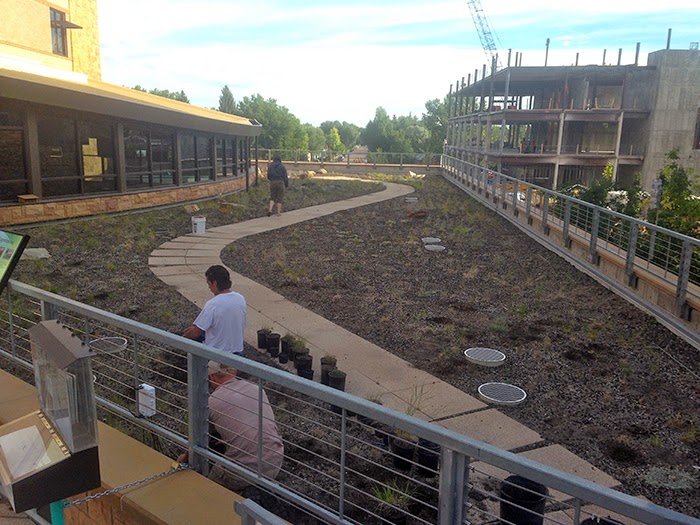
Indeed, the Berry Prairie has changed a lot this year.  In a lot of ways.  A new design, a new plant list, a new irrigation system, a new mulch cover, and all just in the time for the snow. 

Laramie experienced a wonderful, long fall.  Temperatures were mild through all of September and October, and only this past week did we get any substantial snowfall.  We're thanking our lucky stars, and hoping this bodes well for the new green roof plants come spring.

But for now, we enter our winter senescence.  Until spring, here are a few photos of the roof as you'll see it.


 Written by Brenna Marsicek, UW Biodiversity Institute

Friday, August 22, 2014

Tuesday, August 19, 2014

Remodel: End of Day 1

The signs of progress:


But still a LOT to do:


Written by Brenna Marsicek, UW Biodiversity Institute

The Remodel Begins!


Today is the first day of the Berry Prairie remodel!  We are disposing of all of the dead plants that didn't survive the Roofing Fiasco of 2012, taking the live plants off the roof and putting them into a nursery in the meantime, and then changing the landscape of the roof.  

We're working with the fabulous Allison Fleury of Inside Out Landscape Architecture in Jackson for the design.  UW Facilities Planning, the building architects at Malone Belton Abel, and the contractor, Arcon, are big players in this game too.

The new roof will have 2 berms to add some height and interest, as well as a larger plant list that includes plants native within a 200 mile radius (rather than a 25 mile radius as before).  We'll have three distinct zones showing different ecosystems: prairie, foothills and alpine.  And we're changing our irrigation system to be pop-up smart-sprinklers (that can gauge wind speed, recent rainfall, humidity, etc. and change their sprinkling accordingly).  


A few photos of the initial steps:

1.  Remove all dead plants (leaving little craters that make it look like we play polo on the green roof)


2. Pot up tiny seedlings that might get trampled in the process


3. Pot up the rest of the plants for safe keeping during the remodel


Stay tuned for more updates!


Written by Brenna Marsicek, UW Biodiversity Institute

Wednesday, May 21, 2014

Berry Prairie Remodel!

This summer, the Berry Prairie will be undergoing an overhaul!  We are in the final planning stages of designing the green roof remodel, and hope to start in the beginning of July.  The new green roof will include many of the same plants, plus others that are native to within 200 miles of Laramie, but will have a very different look.

Whaaaa?  It's only 3 years old!

A few of you might be looking at this screen thinking YOU CRAZY UNIVERSITY PEOPLE!  YOU JUST PLANTED IT!  And of course we are slightly cooky, but this is for a good reason.

A little backstory (if you know it, skip down to the next section)

The green roof was installed in June 2011, with 4,400 plants native to the Laramie area (within 25 miles or so).  The plants did splendidly the first summer and winter, and in spring 2012, we had lost only 7% (or 308) of the plants.

Berry Prairie, June 2011

Then during the spring of 2012, the company that installed the green roof came back to put in the leak monitoring system, and accidentally cut through both membranes of the roof that separate the soil, water and plants from the room below.  This caused a major water problem, resulting in the removal of all of the plants, soil and layers of the roof until the problem was fix.  

Berry Prairie, August 2012

All of the plants hung out on the golf course in the meantime. 

Berry Prairie Refugees, August 2012

Then, once fixing the roof was complete, they all went back on.  Which means the plants had been transplanted a total of three times (first into the roof in 2011, then into pots in 2012, then into the roof again in 2012).  This transplant shock is what we think killed approximately HALF of our plants.

2013 was a rough year for the green roof.  Ugly and boring.  Boo. 

Berry Prairie, August 2013


Fortunately, we had leftover funds from the building construction project that we could use on building-related expenses.  And we have a team of dedicated Berry Prairie enthusiasts that want to make this place simply awesome.  So we decided to take this as an opportunity to rethink how the green roof looks and functions, and replace the dead plants in the process.

Remodel Plans

With the help of Allison Fluery out of Jackson and Mark Fusco out of Denver, we have big plans for the Berry Prairie.  The new edition of the green roof will have more topography and vertical interest.  We'll install two large berms that will reach 2 feet above the current soil level, and we have dwarf trees and more shrubs on the plant list.  The plants will come from a broader geographic range, but will still be local to the Rocky Mountain region.  We will have three distinct zones: plains, foothills and alpine.  And much more!!  I wish I could share every detail of the plans with you!

But that's all you get for now.  Stay tuned for more information and updates!


Written by Brenna Marsicek, Biodiversity Institute

Friday, June 28, 2013

Water Wise?

We have spent a lot of time boasting about the native plants on our green roof, and how they're naturally drought-, wind-, and sun-tolerant, so are ideal for this rooftop setting.  I've also mentioned a few times that Laramie is quite arid – we typically receive around 11 inches of precipitation (including water weight in snow!) per year – only 1 inch more than what classifies a place as a desert. 

So what's with the sprinkler?


As much as we'd like to think that we're perfectly mimicking a natural prairie on our green roof, it's obvious we can't do it in every way.  We can't let pronghorn loose on the roof (though that would be sweet!) and we can't set fire to it (oh goodness, can you imagine the ruckus?).  


And we can't recreate all of the benefits that groundwater, soil depth and topography bring to plants in a natural setting. 

Native v. Natural

We need to be careful when we describe the green roof as mimicking a local prairie.  To clarify:  We use native plants.  We don't pretend this is a natural environment.


In a natural prairie, plants have incredible root systems that, depending on the plant, can grown many, many inches, even feet, into the soil to access groundwater and moisture that our 8-12 inches of green roof soil medium can't provide. 

Topography can also play an important role in a short-grass prairie, providing nooks and crannies for plants to grow in, protected from constant wind and sun and benefited by piled snow and rain run-off. 

The green roof is also surrounded by concrete and brick – increased evaporation due to heat island effect is likely a player as well.  And while we're on the topic of evaporation, look at the color of the soil on the roof compared to the native prairies.  We suspect the dark color absorbs more heat from the sun and evaporates moisture more quickly than in prairie soils.


Natural prairie soil

Green roof "soil"

Furthermore, this isn't just a green roof, it's also a showcase garden.  As such, the aesthetics do matter to some extent.  In order for the Berry Prairie to look as beautiful and healthy as possible, we want to give it an extra boost with supplemented water every so often. 

We also have an drip irrigation system set up, which allows for us to soak the roots when the soil dries out.  We can verify whether the soil is saturated, moist or dry through manually trenching or coring the soil, or through the soil probes we have set up throughout the roof.  The probes are set 4 inches below the surface and measure soil temperature and moisture every hour of every day.


Water Usage

With all this said, we try to be really careful to water only what we need to in order to ensure the health of the plants.  We have watered 4 times so far this summer using a sprinkler and the drip system.  It's a manual process, not automated, so if it rains or if it's cool, we don't need to turn on the sprinklers.


What do you think?  Is it right to water our green roof?  How much, how little, how often, and at what cost?


Written by Brenna Marsicek, Biodiversity Institute

Thursday, June 6, 2013

Dead or Alive

Kyle and Jenna note the living and dead plants within
a plot on the green roof.
Today is survey day.  Kyle Bolenbaugh, the Master's student in Botany studying survivability of the plants on the green roof, is determining which plants survived the winter (and the hectic summer before it).

To do this, Kyle meticulous goes through random plots in different parts of the green roof, and identifies all of the plants within it as well as whether it's alive or dead.  Jenna then marks it down on a spreadsheet.  This is done over the course of multiple years (this is his second survivability count), which allows us to determine survivability over the long term.


Why do we care?

The Berry Prairie is an unusual green roof.  Instead of covering it with a few species of sedum, as is quite common, we went out on a limb to see if we could mimic a prairie, and used 62 species of flowers, grasses and shrubs in the process.  

There are a few other places that have done this (the Church of Latter Day Saints Conference Center in Salt Lake City is one), and we want to be able to say - with data backing our statement - that this strategy does or doesn't work for green roof design.

Heck, if these plants were able to survive being dug up, hauled out to the golf course, plopped there for a couple of months, and replanted just before fall arrived last year, they might be the hardiest of the hardy, and ones we can recommend for use on other green roofs.

For example, Oregon grape (Mahonia repens) and knicknick/bearberry (Arctostaphylus uva-ursi) is very common in natural settings, but completely croaked on the green roof.  Who woulda known?

The Grand Experiment continues - stay tuned for results!


Written by Brenna Marsicek, Biodiversity Institute

Wednesday, September 5, 2012

A Return to Normalcy

After three full months of chaos surrounding the green roof defects (holes in the roof caused by human error, pulling up the green roof, drying out and replacing the roof layers, flood testing the layers and putting the soil back on), the plants are going back in!


The process started yesterday (Tuesday) morning.  The plants were hauled from the Jacoby Golf Course in northeastern Laramie to the Berry Center, where they were grouped by section (section indicated by the different colored tags in the plants and by tape on the railings) and identified by species (the number listed on each tag).


Then, following the original map created by the architectural firm that designed the Berry Center and the green roof, Malone Belton Abel, we arranged the plants as closely as we could to the original schematic.  This is important not only from a design standpoint, but also for Kyle's research


We spent all of yesterday and half of today just arranging plants.  Thousands and thousands of plants. 


And at 1:00 this afternoon, the crew started the last phase: plant installation!


More soon, as these plants readjust to life on a green roof before fall arrives.

Written by Brenna Wanous Marsicek


Thursday, August 30, 2012

Prairie Reconstruction

The past two days have been impressively productive on the green roof.  Once the leak monitoring system was check out (see "The Last Leak Test"), the landscape fabric, gravel, irrigation system and growing medium have been put back on, and today the pathway and boulders were reinstalled.  Take that Humpty Dumpty!

Some photos to tell the story:

The crew laid a layer of growing medium and then the drip irrigation system, to be followed by another layer of "soil."


The massive conveyor belt that moved the growing medium onto the green roof. 


The pavers are patiently awaiting reinstallation.

Pathway going back in!  The construction company followed the original blue prints to match what was in place before.


Hauling boulders to put back on the green roof.

 
It's starting to look like normal!

The crew is mounding up the hills again to mimic what the prairie was like before.

The plants will go back in on Tuesday, September 4!


Written by Brenna Wanous Marsicek, Berry Center


Wednesday, August 29, 2012

The Final Leak Test

The roof passed its first leak test with flying colors (see "Moment of truth") and its second, and its third. These last two were to find leaks in the top membrane, and were, like the first, accomplished by flooding the roof and letting the water stand for at least 24 hours.  But—how to tell if there’s a leak in the top membrane when we know there’s none in the bottom? A leak in the bottom membrane would result in water in the collection room (Oh No!), while a leak in the top membrane would only mean water between the membranes. Invisible? Yes. Undetectable? NO!

The roof was designed and built with a leak detection system specifically to pick up leaks in the top membrane BEFORE there’s a hole in the bottom membrane. 

Here’s how it works:
Between the two membranes is a screen that looks like ordinary window screening (see the screen in the photo below). A wire is attached to the screen, so that it can be electrified. Above the top membrane there are also wires—generally around the periphery, including around the drains—so that when the surface of the membrane is covered with water, and the wires are plugged in, there is a continuous electric field above the membrane. The electric fields of the screen below and the water above should be completely separate, unless there’s a hole allowing water to connect them. 


Here’s a photo of Adam (International Leak Detector) looking for leaks. The two poles are used to measure the current on the surface. Leaks cause a change in resistance, which is read on the meter around Adam’s neck. Should there be a hole, it can be pinpointed with the two poles.


The test took only about 20 minutes, as Adam walked back and forth. There was a short period of suspense when he stopped walking and poked around, but it turned out to be water running over the lip of the drain, not water running through a hole in the membrane. What a relief!     

To maintain the roof from now on, we’ll be hiring Adam’s employer now and then to re-run the test. They can do this through up to six feet (!) of material above the membrane, so long as the membrane surface is thoroughly wet. This way, we’ll never again discover a leak using the flood-the-collection-room detection system. 

Written by Dorothy Tuthill, Berry Center


Friday, August 24, 2012

The Hold Up

In the west, a hold up can have a couple of meanings.  Think stage coaches and canvas bags with a big $ on the side.


But in the context of the Berry Prairie, it refers to the lack of progress on the green roof this week.  The green roof still looks like this (below) largely because everyone is being extra careful to make sure the membrane system is 100% waterproof.  A worthy cause for a hold up, most certainly, but still a bit of a rain on the parade.


Interesting Landscape Additions
 
But we do have an additional "accessory" outside the Berry Center, which right now is more decorative than functional:


This bad boy is the conveyor belt that will facilitate putting the soil back on the green roof.  Because part of the patio surrounding the green roof is part of the roof, we can't back a big truck right up to the edge of the prairie, lest we create bigger and more destructive problems should the truck fall through the roof into the Vertebrate Collection.  Slightly worse than water damage.

The growing medium is held in these bags, cinched up tight to prevent weed seeds from blowing in and medium from blowing away.  The medium and the conveyor belt should be in action on Tuesday, the 28th.  Keep your fingers crossed!


Written by Brenna Wanous Marsicek, Berry Center

Tuesday, August 14, 2012

Progress and Variety

The green roof's first membrane has been proven waterproof!  Hooray!  Now the next layers of metal mesh, which is a component of the leak monitoring system, felt and membrane #2 go on.  Below you can see that one section of the green roof is receiving its second membrane already. 


Variety Hour

And because we've had FAR too much orange in our pictures this week and last, here are a few to switch up the biodiversity:

Bombus huntii, or Hunt's bumble bee gathers pollen from a non-native Echinecia near the Berry Prairie. 
We installed a new Penstemon Biodiversity Garden in the alley behind the Berry Center

A bat has made the Berry Center at least a temporary residence!  Neat little guy!

Written by Brenna Wanous Marsicek