Showing posts with label outreach. Show all posts

Friday, June 5, 2015

Come Sit a Spell


Come drink your morning coffee on the Berry Prairie.  Or sit down with a sketch book.  Or just soak up some sunshine. 

The Berry Prairie is home to two benches that are just calling your name.  The green roof is open to all (except pets and litterers), any day of the week, pretty much any time. 

Come sit a spell in this rooftop landscape.


Written by Brenna Marsicek, UW Biodiversity Institute

Monday, April 14, 2014

Gardening with Native Plants

This is the time of year where are fingers are itching to get in the dirt, when our seed packets are singing our names, and when gardening blogs are seeing their maximum traffic.  It's almost gardening season, and that means it's time to dream and prepare!

Last month, the UW Biodiversity Institute, in collaboration with the UW Extension, Barnyards & Backyards and the Laramie Garden Club just published a book you might be interested in.  It's called "Plants with Altitude: Regionally Native Plants for Wyoming Gardens."

Inside it is a list of about 40 wildflowers (forbs) and 12 shrubs that are native to Wyoming or just beyond, and that we recommend for gardens because they're beautiful, hardy, water wise and you can find them at nurseries or in seed catalogs.  For each plant, there's a photo and description, along with soil, water and sun requirements, and if it's beneficial for pollinators or resistant to herbivores.

If you're thinking about getting native plants into your gardens this year, this book is a fabulous resource.  And it's cheap - $5 if you buy it in person (UW Berry Center on 10th and Lewis St., or at the UW Bookstore), or $8 if you buy it online at www.wyomingnativegardens.org.

http://www.wyomingnativegardens.org 

Written by Brenna Marsicek, Biodiversity Institute

Wednesday, August 21, 2013

Rock Stars in Rock Springs

Rock Springs, Wyoming is home to one heck of a pollinator enthusiast.  Bill and his wife Valjean have lived at their current house for 7 years, and have turned its yard from a barren, weedy wasteland to a lush, overwhelmingly productive heaven.  Seriously, I want to live in their garden.


Throughout their garden, you'll find dozens of brightly colored, oddly shaped, south or east facing boxes and bundles, all with tubes and tunnels, and decorated with flowers and glass beads.  Some call this garden art; but it has a greater purpose than that - these are bee houses.  Leafcutter bee houses, to be exact.  


In Laramie, we have a whole variety of bee species, many as common as others (bumble bees, masons, leafcutters, carpenters, sweat bees, etc.).  A variety of bees are found in Rock Springs too, but leafcutter bees are king.  You can ask me why, but I don't know.  Leafcutter bees are fabulous little pollinators that are solitary (don't live or work in groups), hairy (pollen collects on the bottom of their abdomen), usually striped black and gray, and have a scissor-like feature on their mouths that allow them to cut little half-circles from leaves to make their nests.  

A page from the "Laramie Area Pollinator Pocket Guide" -
available at Berry Center 231 or online here.

Who Cares?


When we asked Bill why he puts so much effort into keeping bee boxes in his garden, he said they had very low pollination in the garden before he started keeping native bees.  As in the cucumbers would flower but wouldn't produce any cukes - there was a critical piece missing.  And a good beekeeper knows that bees need primarily three things: food (flowers), water and... that's right, shelter.  Now that he's  providing all three components, their garden is flourishing!


These bee houses are all facing south or east to keep the nests warm without cooking them (west-facing houses would get hot afternoon sun).  They are at different heights, but the lowest is approx. 4 feet high, and the highest is approx. 7 feet high.  The blocks of wood are all at least six inches deep, with holes drilled into them perfectly horizontally (important for nesting), and they're secured firmly to whatever they're attached to (important for larvae).  


He uses a bunch of different mediums for nesting habitat: lumber, stumps, straws, styrofoam insulation, and lots of bamboo sticks.  The bamboo sticks seem to be very successful, as well as the insulation,  but the bees are actively nesting in all different mediums.  The holes that are plugged are active nests.


The Bigger Picture

Pollinators are the backbone to our food system and to our ecosystems.  Without pollinators, we wouldn't have things like raspberries, coffee and almonds, nor would we have places like flowering woodlands and prairies.  This example of proactively caring for pollinators shows that providing a little extra space for bees can turn a sad-looking yard into a beautiful garden, and maybe a sad-looking prairie into a beautiful meadow.


Check out this website for more resources: http://www.uwyo.edu/biodiversity/pollinators/resources.html


Written by Brenna Marsicek, Biodiversity Institute

Thursday, May 31, 2012

Penstemon Press

Photo by Bonnie Heidel, WYNDD, also quoted in the article
The Casper Star Tribune (Wyoming's statewide newspaper) article, "Hike takes people to state’s only endangered plant," published today, discusses penstemons and the upcoming American Penstemon Society/Wyoming Native Plant Society meeting in Laramie on June 22-25.  The endangered plant the article refers to is the Blowout Penstemon (Penstemon haydenii, shown right), found only in active sand dunes like those in central Wyoming.  


Our very own Dorothy Tuthill is quoted in the article,  as she happens to be an expert on penstemons, particularly those found in Wyoming.  You may have read about the variety of penstemons we feature in the Berry Prairie.  The species found in Wyoming are extremely drought tolerant plants, and in fact prefer very little water over regular watering.  In a recent presentation to the Laramie Garden Club Dorothy noted some species' "flowers are even more vibrantly colored when they're drought stressed than when they're well watered."  

Below are photos of the two penstemons in bloom in the Berry Prairie, the Fuzzytongue (P. eriantherus) and Blue Mist (P. virens) penstemons. 

The Berry Center is also installing a penstemon garden this summer to showcase the impressive diversity within one genus, so stay tuned for more updates!

Fuzzytongue Penstemon, now blooming on the Berry Prairie!

Blue Mist Penstemon, also blooming on the Berry Prairie!

Written by Brenna Wanous, Berry Center


Wednesday, May 2, 2012

Pollinator Provisions

We are going a little nuts for pollinators here at the Berry Center.  Our native pollinators are absolutely critical to food production, ecosystem functioning, plant and therefore many other types of biodiversity, and they're also in decline (generally speaking).  And did you know that June 18-24 is Pollinator Week??  Stay tuned for Berry Center activities during that week!


We're not talking about honeybees, though honeybees are wonderful for their own reasons.  We're thinking about native bumblebees, mason bees, carpenter bees (and other bees), butterflies, moths hummingbirds and other native species.  They've evolved with our native plants and predators, and so are well suited for our climate.

Honeybees were imported from Europe, and their species are the ones experiencing colony collapse disorder.  But native pollinators are also taking a hit, for a number of reasons known and unknown (pesticide use?  land use changes leading to habitat loss?  reduced use of native flowers in landscapes?).  

We decided to do our part to help protect their populations.

Step 1: Soak  up as much knowledge as possible

So we're learning all that we can about how to provide for native pollinators, and a cool resource is in the works - I'll upload that when it's finished!  Some of our main resources include:

Attracting Native Pollinators published by the Xerces Society, an incredible organization that does great work on pollinator conservation.  This book is absolutely wonderful.


Attracting Pollinators to Your Garden Using Native Plants put out by the US Forest Service.  This is what the pages on leaf-cutter bees and mason bees looks like.


Bee Basics: An Introduction to Our Native Pollinators by Beatriz Moisset and Stephen Buchmann and sponsored by the US Forest Service and the Pollinator Partnership, another great org.


Befriending Bumble Bees: A practical guide to raising local bumble bees by Elaine Evans, Ian Burns and Marla Spivak at the University of Minnesota Extension.  We used this book to learn how to build rearing nests (see below), how to feed the bees, and for general bumblebee resources.


We also have invaluable collaborators around campus and beyond!


Step 2: Put some of this into action!

We have put a few of these ideas into action, and have plans for a few others.  We know pollinators need food, shelter and water, so we've provided those for a few types.  

Food consists of the plants on the green roof:


Shelter includes the bee condos in the background of the photo below, and water via the bird bath in the foreground.  (Quick note, some insects can't break the water tension at the surface of the water so they can drink it, so you need to float a few sticks or add gravel to the bird bath to help them out.)


We also have caught a queen bumblebee (Bombus huntii) and are raising it inside so she will lay eggs and we can transfer that to an outdoor bumblebee nest that we put on the green roof.  You can see her in the nest box below.  We got the methods for building the nest from the Befriending Bumble Bees book shown above.


The outdoor bumblebee nest will look something like this:

This one was built by Katie Haynes at the US Forest Service station in Laramie

And of course you can't ignore the wonderful hummingbirds.  We added one and will add one more hummingbird feeder outside the Berry Center.  But these birds can also eat insects, so we placed the feeder away from the green roof where we are fostering our insect pollinators.


Step 3: Do some outreach!

We are working hard at collaborating with other groups in town to spread the word about native pollinators.  The Berry Center is hosting a pollinator night with the local Boy Scouts next week, and during Pollinator Week (June 18-24) we will hold pollinator surveying parties!  Check back soon for more info!


We'll keep adding more and more info about pollinators as we figure it out or at least attempt to! 


Written by Brenna Wanous, Berry Center

Thursday, April 26, 2012

Be Our Guest!


The Berry Center welcomes anyone to come explore our green roof, which is better known as the Berry Prairie.  In the spirit of Lumiere and Cogsworth in Beauty and the Beast, this post is constructed to show you just how welcome you are!

Guest Book and Brochure Rack

The Berry Prairie now features a guest book and brochure rack!  Information about the green roof and the plants it holds, as well as the Berry Center, are available for the taking.  Also, please sign the guest book to say hi and let us know what you think!!


Visitors explore the plants in the Berry Prairie

The first comments in our guest book!

Name Tags 

Many of the plants are labeled for your convenience - and we will continue to add labels as plants emerge from their winter slumber.  If you have any questions, feel free to stop in the main office inside the Berry Center doors and to the left.  Dorothy or I will be happy to provide answers!

Sorry Fito


One group of creatures we don't welcome are pets.  Dogs in particular find the open space an irresistible place to run in, which unfortunately can and has uprooted and trampled plants.  So sorry Fito, you have to stay out. 


 Stop by to check out the Prairie next time you're on this side of campus!


Written by Brenna Wanous, Berry Center

Friday, October 14, 2011

Biodiversity Scavenger Hunt

If you're in Laramie and are looking for a fun, family activity today and this weekend, check out the Berry Center's UW Biodiversity Scavenger Hunt!  There are nine questions and clues that will lead you all over the main part of campus where you'll discover some surprising and fascinating biodiversity tidbits.  


How to Scavenge: 

Wander around campus today (you need to visit some of the locales during business hours today - see the clue sheet for more information) and tomorrow to find the answers.

Once you've completed as many questions as you can, submit your answers online.

The Prizes:
The three individuals or groups (you can work in groups of no more than three people) with the most correct answers will win a ticket per person to one of the following locations (winner chooses):
  1. Denver Zoo (rawr!)
  2. Denver Museum of Nature and Science (best museum ever!)
  3. Denver Botanic Gardens (purdy!)

Email bwanous@uwyo.edu or call 307-766-6240 or stop in Berry Center 231 with any questions.

Written by Brenna Wanous, Berry Center


Monday, September 12, 2011

Up on the Roof: Denver EPA

Last Wednesday, the Berry Center staff - including Greg Brown (Director), Dorothy Tuthill (Associate Director), Kyle Bolenbaugh (Graduate student) and me (Office Manager) - took a road trip.


Ok, not that kind of road trip.

Remember when the folks from the Environmental Protection Agency in Denver came to visit the Berry Prairie?  We made a return visit to learn more about what their green roof is like and what they hope to accomplish through collaboration.

The EPA's Green Roof

Their green roof is on top of an 11 story building in central Denver, and the EPA crew is interested in revamping it to be more diverse and sustainable. The current green roof is a common commercially-installed green roof, with lots of trays and sedum and gravel-like soil medium.  From what we could tell, the 5 year old plantings were about 30-85% living, depending on the area and the trays.

The EPA's green roof, set near downtown Denver.

The green roof is set on three different stories.  It was planted in 2006 to be a research site, coordinated by Colorado State University, to examine green roof design and impacts on the building below.  Approximately 19,200 square feet were planted with five species of sedum in these 4'x2' trays that are about 3 inches deep. The EPA waters these plants for about 15 minutes per day, every day, and water allocations vary from level to level - with the most of the water allocated to the top level where wind shear and evaporation rates are the highest.


Located on the top three stories of the skyscraper, the green roof experiences significant wind shear, which is one of its biggest problems.  Here, Greg and Dorothy face the elements to examine the plants.

The So-What

The EPA and the Berry Center are trying to find ways of partnering to advance green roof research, and by the by, hopefully help this Denver green roof become a more biodiverse and successful space.  Along the way, we would anticipate answering questions like:

How do we select plants for this specific location and for this urban environment?  How can we help make this green roof sustainable - both in terms of biology and maintenance?  How does increasing depth of soil influence plant success and survivability?  How can we make this roof educational, in addition to functional and beautiful? 

Weather monitoring is an important component to the green roof.  Here wind speeds, humidity, pressure and temperature can be assessed on a daily basis.

We haven't formalized any working relationships yet.  But putting feelers out to these great resources is a good way to put the Berry Prairie into perspective and to good use!


Written by Brenna Wanous, Berry Center


Friday, August 5, 2011

EPA Visits the Prairie

Yesterday the Berry Prairie hosted eight visitors from the Environmental Protection Agency (EPA) in Denver, who have a great green building (check out their website!).  Atop their great green building is a living roof that unfortunately isn't quite living anymore.  

The group came to Laramie because would like to revamp their green roof, maybe using the Berry Prairie as a model!  How cool is that?!   (And not to pat ourselves on the back too much, but they found us through the Berry Prairie blog.)

Greg Brown, Berry Center Director (center-left in the black shirt) explains the structure and plant list of the green roof to some of the EPA guests.

The group was interested in the Berry Prairie for its unique approach to green roofs - native plants?  No trays?  No monoculture?  Pretty uncommon in the green roof movement... for now.  So Greg and Dorothy led the group through the Berry Prairie to give them a close up,  hands-on look at all that comprises the green roof.

The group was interested in everything from plant selection to structural integrity, the soilless "soil" to irrigation regime.

The EPAers also took a tour through the rest of the Berry Center, including into the Vertebrate Collection, which is directly below the Berry Prairie, to check out how everything ties together.

Greg (center-left) explains how the Vertebrate Collection plays an important role in the Berry Center and its mission.  Not unintentionally, the Collection room is located directly below the green roof, where it benefits from more stable temperatures and climate control.

We were thrilled by their visit and hope to travel down to Denver in the near future to examine their green roof as well.  This is a learning process for everyone, and we're happy to form a new partnership with our friendly neighbors to the south.

Written by Brenna Wanous, Berry Center


Monday, August 1, 2011

Cultivating Junior Scientists

This past Friday, a group of children from Children's Discovery Center - a day care in Cheyenne, visited the Berry Center to learn about plants and pollinators.  As you can imagine, we were tickled at the idea of having a bunch of elementary kids interested in learning how the two topics are closely connected, so Dorothy put together a fantastic workshop for them!
Five children from Cheyenne visit the Berry Center to learn about plants and pollinators.  July 29, 2011


Part 1: Berry Center Tour

The kids started out touring the Berry Center to learn what "real-live" biologists and ecologists do.  They visited the Vertebrate Collection, the biodiversity display cases and the "Slow Motion Hurricane" photo exhibit, among other places.

A group of children examine a pocket gopher skull in the Berry Center's Vertebrate Collection.


These children examine patterns in the butterfly wings in the Berry Center's display cabinets.


Dorothy explains the mountain pine beetle and lodgepole pine relationship.  Here she shows the kids what a pitch tube is and looks like.
 
Part 2: Green Roof Pollinators

Dorothy took the group out to the green roof to explain why we planted what we did and how our native plants can help support our native pollinators.  The children then sat quietly for ten minutes watching for pollinators to land on flowers so they could determine what kind and how many insects are visiting the plants.

Dorothy describes the process of pollination.  To get a better look at the reproductive parts of a plant, the kids use magnifying glasses.
The group watches for pollinators to land on the sunflowers and gaillardia.  While these potted plants are not native to the Laramie Basin, they're useful tools for teaching children about insects and plant relationships.


Part 3: A Closer Look at Native Pollinators

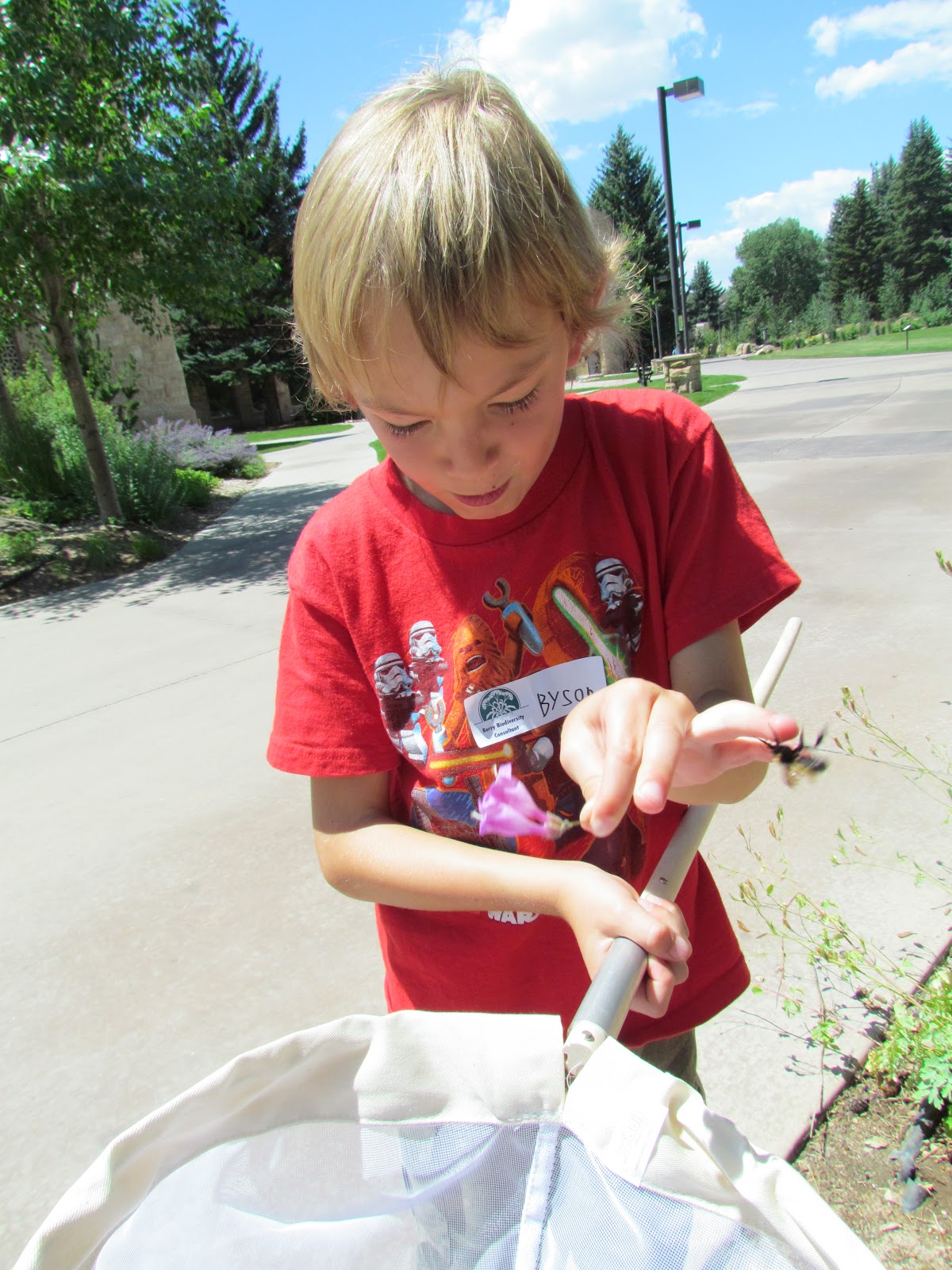
Next, the group moved to Simpson Plaza on the UW campus to see insects close up.  They were given insect nets and taught how to sweep plants to safely catch pollinators.  Bombus, the genus of the native bumble bee, was a popular catch and "I caught a bombus!!" was the day's most frequently used phrase.

Kyle (right) explains how to sweep a net to catch an insect.


Each of the children caught an insect to put in an insect box for closer inspection and identification.  Once the insects were identified, they were released to pollinate more plants.

Part 4: Insect Museum

The children then moved to the last stop: UW's Insect Museum and Gallery, where they could witness the variety of insect species in Wyoming and beyond.  They even got to touch a Madagascar Hissing Cockroach!

Guinevere Jones, PhD student in Ecology, helps students identify insects and describes some of their characteristics and lifestyles.

Guinevere pulled out a hissing cockroach for the children to touch and hold.  Most were content just petting it.


This little scientist wanted to hold the cockroach, and exclaimed "The bottom feels like a turtle shell!!"


If you'd like your child's class to visit the Berry Center, suggest the teacher contact the Berry Center to set up a day and time.  We'd love to have more little scientists to come through!


Written by Brenna Wanous, Berry Center