Friday, June 28, 2013

Water Wise?

We have spent a lot of time boasting about the native plants on our green roof, and how they're naturally drought-, wind-, and sun-tolerant, so are ideal for this rooftop setting.  I've also mentioned a few times that Laramie is quite arid – we typically receive around 11 inches of precipitation (including water weight in snow!) per year – only 1 inch more than what classifies a place as a desert. 

So what's with the sprinkler?


As much as we'd like to think that we're perfectly mimicking a natural prairie on our green roof, it's obvious we can't do it in every way.  We can't let pronghorn loose on the roof (though that would be sweet!) and we can't set fire to it (oh goodness, can you imagine the ruckus?).  


And we can't recreate all of the benefits that groundwater, soil depth and topography bring to plants in a natural setting. 

Native v. Natural

We need to be careful when we describe the green roof as mimicking a local prairie.  To clarify:  We use native plants.  We don't pretend this is a natural environment.


In a natural prairie, plants have incredible root systems that, depending on the plant, can grown many, many inches, even feet, into the soil to access groundwater and moisture that our 8-12 inches of green roof soil medium can't provide. 

Topography can also play an important role in a short-grass prairie, providing nooks and crannies for plants to grow in, protected from constant wind and sun and benefited by piled snow and rain run-off. 

The green roof is also surrounded by concrete and brick – increased evaporation due to heat island effect is likely a player as well.  And while we're on the topic of evaporation, look at the color of the soil on the roof compared to the native prairies.  We suspect the dark color absorbs more heat from the sun and evaporates moisture more quickly than in prairie soils.


Natural prairie soil

Green roof "soil"

Furthermore, this isn't just a green roof, it's also a showcase garden.  As such, the aesthetics do matter to some extent.  In order for the Berry Prairie to look as beautiful and healthy as possible, we want to give it an extra boost with supplemented water every so often. 

We also have an drip irrigation system set up, which allows for us to soak the roots when the soil dries out.  We can verify whether the soil is saturated, moist or dry through manually trenching or coring the soil, or through the soil probes we have set up throughout the roof.  The probes are set 4 inches below the surface and measure soil temperature and moisture every hour of every day.


Water Usage

With all this said, we try to be really careful to water only what we need to in order to ensure the health of the plants.  We have watered 4 times so far this summer using a sprinkler and the drip system.  It's a manual process, not automated, so if it rains or if it's cool, we don't need to turn on the sprinklers.


What do you think?  Is it right to water our green roof?  How much, how little, how often, and at what cost?


Written by Brenna Marsicek, Biodiversity Institute

Tuesday, June 25, 2013

Prairie Spotlight: Stonecrop Sedum

Stonecrop sedum (Sedum lanceolatum) is a drought-tolerant, sun-tolerant, wind-tolerant, abuse-tolerant plant that is common found on green roofs for those reasons.  In addition to is toughness, it also has beautiful flowers, shown below.


Stonecrop sedum in bloom on the green roof, June 25, 2013

Note the round, spongy leaves of stonecrop (shown below)—an adaptation for survival in extremely dry environments. In the wild, you may find stonecrop growing in very thin soils on rocks, where the only moisture is from recent precipitation, quickly lost in the hot sun. Stonecrop is a succulent, a plant that holds lots of water in reserve within its own tissues—like a cactus, another succulent. Stonecrop has another adaptation that further enhances its ability to succeed where normal plants would shrivel, which involves its ability to retain its precious water reserve.

The leaves of the Stonecrop sedum

CAM Photosynthesis

All plants must open their stomata (small pores on the leaf surface) to allow CO2 to enter, in order for photosynthesis to occur. But, open stomata also allow water vapor to escape. Some plants have evolved a more efficient method to fix the CO2 (called C4 photosynthesis) that doesn’t require keeping stomata open all the time (see grasses blog), thus reducing water loss. Stonecrop, and its relatives in the sedum family, Crassulaceae, have taken C4 photosynthesis one step further—not only are they efficient so that stomata are not open much, but the stomata are open only at night.

Most plants are just the opposite! Since photosynthesis can occur only when the sun is up, that’s when they take in CO2 to make sugars. At night, when sugar can’t be made, they shut their stomata to conserve water, even though the lower temperature and higher humidity of night mean less water would be lost then. But these clever succulents have evolved a method to store nighttime-collected CO2 until it can be used the following day. The CO2 is incorporated into organic acid molecules and stored in vacuoles during the night, then converted into a usable molecule for photosynthesis during the day.

This process is called Crassulacean Acid Metabolism, or CAM, named for the sedum family. But it’s not restricted to one family—a variety of very drought tolerant plants use it, including yuccas, agaves, cacti, some orchids, even some unusually drought tolerant ferns. We have several CAM plants on the Berry Prairie, and you may have them where you live, too. 


Written by Dorothy Tuthill, Biodiversity Institute

Tuesday, June 18, 2013

Prairie Spotlight: Sagebrush

Wyoming residents tend to have a misconstrued conception of sagebrush: “The brown-green stuff that grows everywhere.” Many ranchers would like to reduce its abundance because it is poor livestock food; it competes with preferred grasses for water and nutrients. However, wildlife biologists recognize sagebrush as feed for deer, elk, and pronghorn antelope during the winter. Some view sagebrush as barren land, while others appreciate its unique aroma especially after a summer rain. [1] 

Artemisia tridentata: the name means
3-toothed, a feature of the leaves.
There are five major types of sagebrush in Wyoming: Artemisia cana (Silver sage), Artemisia tridentata (Big sagebrush), Artemisia frigida (Fringed sage), Artemisia nova (Black sage), and Artemisia pedatifida (Birdfoot sage). All of these can be found on the Berry Prairie. 


Artemisia peatifida: this sagebrush is restricted
to most of Wyoming, and only a small part
of south-central Montana.


Why Care about Sagebrush?

Sagebrush is interesting because it grows in places like Wyoming where there is little rain, winters are harsh, and high winds. It depends on the wind for pollination. Second, it provides critically important habitat for a number of wildlife, such as sage grouse, sage thrasher, sage sparrow, and pygmy rabbits.[2]  Third, sagebrush is interesting because the genus belongs to the family Asteraceae, the same family as the sunflower even though it does not have the pretty flowers as the sunflower does. 


Photo by Cody Bish
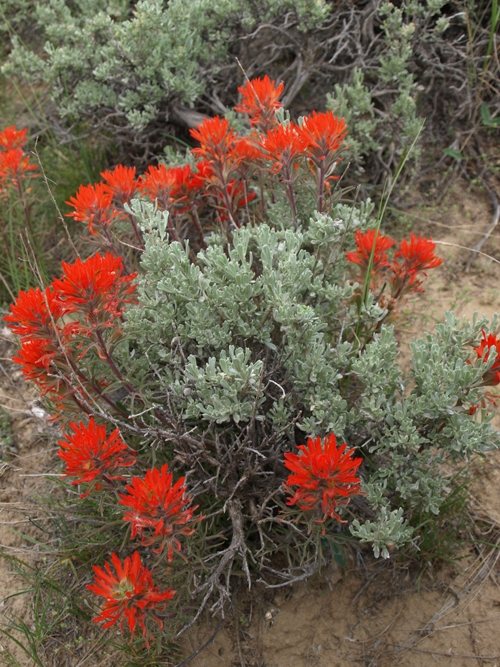
Finally, sagebrush is an important host plant for a favorite wildflower. It is often used as a host plant for Castilleja or Indian paintbrush. The roots of sagebrush display an opportunistic growth strategy. It produces a taproot that elongates into the ground to reach available soil moisture, and also a network of roots that spreads laterally, giving the Castilleja haustoria roots a network to connect with.


[1] Dennis H. knight Mountains and Plains. The Ecology of Wyoming Landscapes

[2] Pocket Guide to Sagebrush


Written by Jenna Ramunno, Biodiversity Institute

Wednesday, June 12, 2013

Rock Garden

Penstemon virens is in bloom! It’s a lovely purple gem on the Berry Prairie, but it blooms even better on the rocks of our patio. These rocks—and those all across campus—were collected in the hills to the east of Laramie, and came with their own rock gardens! 


Blue Mist Penstemon (Penstemon virens)

Penstemon is a large genus of wildflowers with snapdragon-like flowers, usually in red, pink, purple or blue. The Berry Prairie is home to five species, one of which white—an atypical color for penstemons. More on that one later—its buds are still small.  “Virens” means green, a reference to the shiny, dark green leaves of P. virens. Despite its relatively small size (usually less than 10”), it provides lots of color this time of year because it’s both abundant and floriferous. It can be grown easily from seed, if you want it in your garden, and can sometimes be found at nurseries, too.

Our rock gardens include more than P. virens:  A quick sampling includes a currant bush, a groundsel, and a scientist on lunch break!


Groundsel growing with penstemon virens

Current bush in the rock

Homo sapien amongst the vegetation


Written by Dorothy Tuthill, Biodiversity Institute